
Research
Many of the systems we most want to understand (such as the molecules reacting inside a living cell, an infection moving through a population) evolve through discrete, random events, and we can only ever measure part of what is happening. My research asks a question: given partial measurements, how do you reconstruct the hidden state of a system and infer the parameters that govern its dynamics?
I work on this problem for stochastic reaction networks, a flexible modeling language that captures intracellular chemistry, epidemics, and population dynamics within a single mathematical framework. The methods I develop are particle filters and Bayesian inference algorithms.
Reconstructing hidden dynamics from partial data
In most real experiments you can observe some quantities but not others. You might track one protein with a fluorescent reporter while the rest of the network stays invisible; you might see weekly case counts while the underlying chain of transmission is hidden. The inference task is to recover the full, unobserved trajectory from these partial observations.
We developed a Monte Carlo particle filter that solves this problem for a continuous-time Markov chain observed exactly but only in part, reconstructing the hidden species in real time from a continuously observed one (Rathinam & Yu, J. Chem. Phys., 2021).
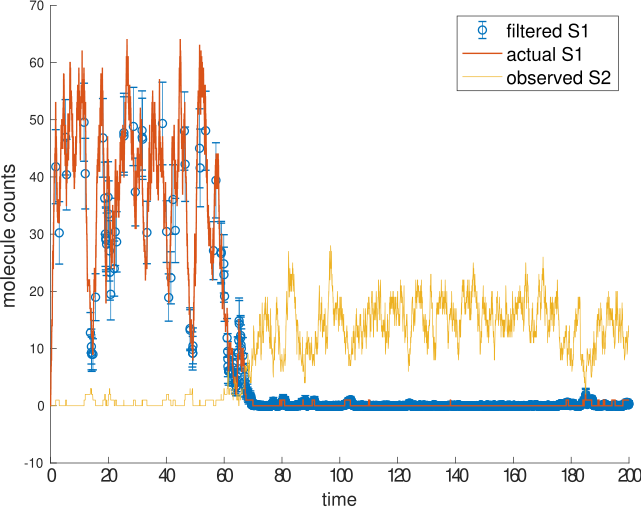
A genetic toggle switch. Species S₁ is reconstructed (blue, with credible intervals) from the observed trajectory of S₂ (yellow). The estimate follows the true S₁ (red) through the switching event near t = 65, where the circuit flips from S₁-high to S₂-high.
In practice, data rarely arrive as a continuous stream. They come as snapshots. This regime is deceptively hard. Because each snapshot is observed exactly rather than noisily, the observation acts as a hard constraint. The natural baseline, a simple accept/reject filter that simulates trajectories and keeps the ones matching the data, almost always rejects: a path drawn from the unconditioned dynamics rarely lands on the next observation exactly, so the surviving ensemble shrinks to a handful of samples. Our targeting algorithm exploits the linear constraints imposed by the observed state to steer particles toward target states, thereby increasing the effective sample size (Rathinam & Yu, J. Comput. Phys., 2024).
Inferring the underlying parameters
Reconstructing hidden states is only half the problem; usually the rate constants that govern the system are unknown too. The same machinery extends naturally to these parameters: by treating each unknown constant as a frozen random variable and filtering over the enlarged system, the algorithm returns a full posterior distribution over parameters rather than a single point estimate.
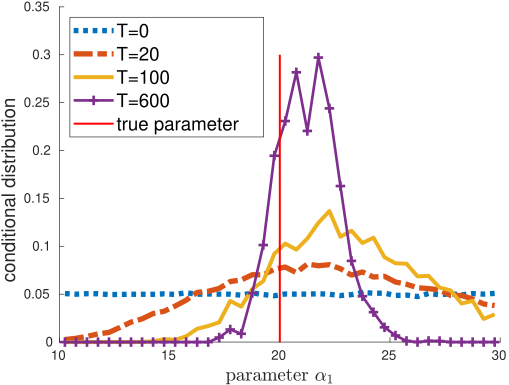
Inferring diffusivity from fluorescence data
A second thread of my dissertation works with a laboratory measurement: fluorescence correlation spectroscopy, where the diffusivity of a labeled molecule is recovered from the autocorrelation of a fluctuating intensity signal. I presented an alternative mathematical derivation of the autocorrelation function, obtained an integral expression and a closed-form upper bound for the variance of its time average, and used Monte Carlo simulation to compare nonlinear least-squares fitting strategies and analyze the sensitivity of the recovered diffusivity.
Where this connects
The mathematics here is the mathematics of inference for partially observed stochastic systems, and it reaches well beyond chemistry:
Systems biology. At the low molecule counts typical of gene expression and signaling, deterministic and Gaussian approximations break down and the discrete, stochastic description becomes essential. These filters are naturally suited to single-cell and time-course data and point toward predictive biological digital twins.
Epidemiology and population dynamics. Compartmental models such as SEIR are themselves reaction networks; I have tested these filters on an SEIR model directly, and reported case counts are exactly the partial, snapshot observations these methods are built for.
Data assimilation and scientific ML. Particle filtering, sequential Monte Carlo, and Bayesian parameter inference are the probabilistic backbone of uncertainty-aware modeling.
Open directions
- Scaling the filters to systems with many hidden coordinates (high-dimensional inference).
- Experiment design and parameter identifiability: understanding what partial data can and cannot resolve.
- Alternative methods for handling integration of principle-driven differential equation models with observation data: data assimilation, scientific machine learning, Physics-informed neural networks, neuro-symbolic AI.
- Formalizing mathematical and scientific knowledge leveraging AI reasoning capacities
Papers, code & talks
- Publications. See the full list, including the 2021 Journal of Chemical Physics and 2024 Journal of Computational Physics papers.
- Code. MATLAB implementations, by paper:
Filtering_ChemNet_examples(continuous-time filter and the genetic-circuit, toggle-switch and SEIR examples, 2021),Filt_GT(the targeting algorithm for snapshot observations, 2024), andFCS_Sim_Fit(fluorescence intensity simulation and nonlinear least-squares fitting). - Dissertation. State and Parameter Estimation in Stochastic Dynamical Systems (UMBC, 2023): PDF. The fluorescence work above is Chapter 2; the filtering work is Chapters 3 and 4.
- Talks. Most recently, Estimating Hidden Dynamics in Stochastic Reaction Networks from Partial Observations at the ICM@ICM 2026 Satellite Conference (Morgan State University) and the CIMBRE Symposium. See Talks.
I am currently seeking postdoctoral positions in applied mathematics, computational biology, and related areas. If you have partial-observation data you’d like to model, or a system where the interesting variables are the ones you can’t measure, I’d be glad to hear from you! email me.